
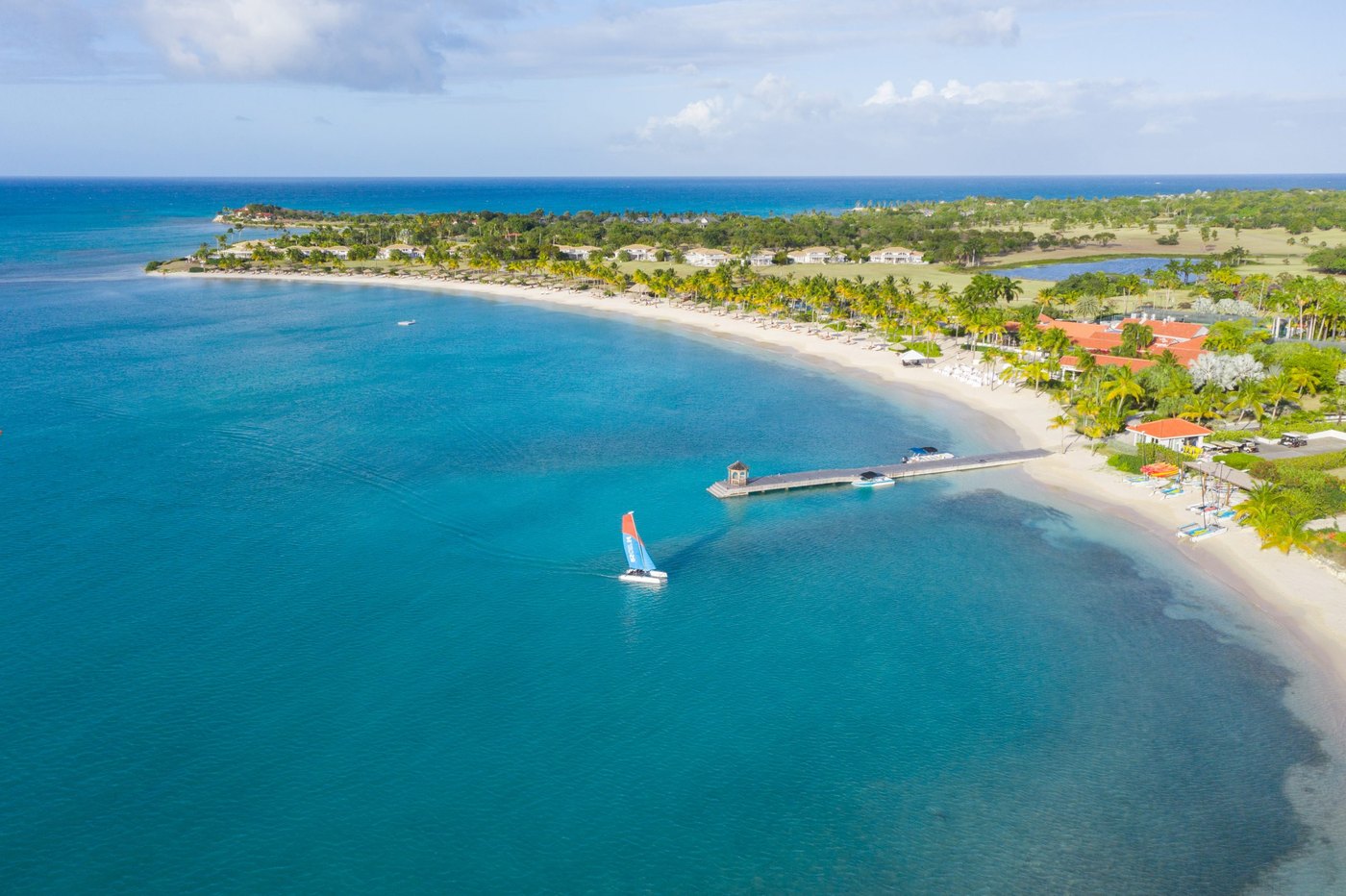
Jumby Bay
A 300-acre private island off Antigua — an Oetker Collection resort with ultra-private homes and estates.
- IslandPrivate island off Antigua
- AnchorOetker Collection resort
- CharacterCar-free, ultra-private
Get the current price list for Jumby Bay
Dan sends what is available now, including residences that are not advertised, with prices, floor plans and terms. He replies personally within one business day.
- Tell Dan what you have in mindBudget, timing and the kind of home. Two minutes, and it stays private.
- Get pricing and availabilityCurrent prices, what is genuinely available and what is coming, within one business day.
- Talk it throughA 30-minute call with Dan when you are ready. No fee, no obligation.
About Jumby Bay
Jumby Bay is a 300-acre private island a short ferry from Antigua, home to an Oetker Collection resort and a small, tightly held community of estates and villas. Oetker Collection took over management in October 2017; the underlying private island, villas and core layout did not change. It's car-free, intensely private, and one of the most established ultra-luxury addresses in the Eastern Caribbean.
Because it's part of Antigua & Barbuda, a qualifying purchase can intersect the country's citizenship-by-investment program. Homes trade rarely; the value is in access and timing.
Read Dan’s full review of Jumby Bay
Jumby Bay is a 300-acre private island off the coast of Antigua, reachable only by boat, and the thing most buyers get wrong about it is which direction the ownership runs. They picture a resort that sells villas around its edges. It is closer to the opposite.
There are 56 private residences on the island, each held individually on a freehold basis. Each one carries a single and equal share in Jumby Bay Island Company Ltd. That company owns the freehold to everything else: the resort, the undeveloped common land, neighbouring Maiden Island, the utilities, the ferries and the docks. The island has belonged to its homeowners since 1998. Buy a house at Jumby Bay and you are not a guest with a deed. You are one fifty-sixth of the landlord.
The second thing buyers get wrong is more expensive. Because Antigua runs a citizenship-by-investment programme, and because Jumby Bay is a well-known Antiguan address, people arrive assuming the two connect. They do not. Jumby Bay does not appear on the Citizenship by Investment Unit’s list of approved development projects, and it is not named in the Unit’s schedule of approved areas. That is worked through below, because it is the single point on which the most confident misinformation circulates. Treat Jumby Bay as a house you want to own, not as a route to a passport.
What you actually own at Jumby Bay
The legal structure is unusual, and it is the reason the island feels the way it does. Each of the 56 properties is individually owned on a freehold basis, and each holds a single and equal share in Jumby Bay Island Company Ltd, which owns the freehold to everything else. The island has been in its homeowners’ hands on this basis since 1998.
Read that twice, because it has consequences a brochure will not spell out.
- You are a shareholder in the company that owns an operating hotel. Not a member of an amenity club. The resort sits inside the company you part-own, which means the hotel’s capital needs sit on the same balance sheet as the island’s. What that actually costs you is a question for the audited accounts, not for a sales brochure.
- Your share of the vote is fixed and small. One share in 56, equal to every other. You cannot accumulate influence by buying a bigger house. Ask for the company’s articles and read how decisions are carried and what majority binds you — that detail is not published anywhere, and it matters more than the view.
- The infrastructure is not a public utility. The ferries, the docks and the power are company assets, held by the company the 56 of you own between you. When they need replacing, that is your balance sheet, not the Antiguan government’s.
- The hotel brand is a contractor, not an owner. The resort has been operated by Oetker Collection since 2017. Rosewood ran it before that, and a great deal of listing copy and older brochures still describe the property under the old flag. That branding is roughly a decade out of date. If the material in front of you says Rosewood, it is old, and you should ask what else in it is old.
Practically, the island runs without cars — they are not allowed — and people move around by bicycle and golf cart. Everything and everyone arrives by boat. Pasture Bay, on the quieter side of the island, is the site of a hawksbill turtle monitoring effort described as the longest-running privately funded project of its kind. It is a genuine conservation programme, and if you are buying anywhere near it, it is worth asking in writing what it implies for what can be built.
The nearest comparison in the region is Mustique, where villa owners also hold shares in the company that owns the island. The difference is that on Mustique a share is not automatically attached to every lot, so what you are buying has to be established villa by villa.
The carrying costs, and the number nobody publishes
The Antiguan side of the cost is set by law rather than by the island company. The Non-Citizen Landholding Licence and its fee, buyer’s stamp duty, the conveyancing scale, annual property tax and the consumption taxes are all set out on the Antigua & Barbuda real-estate guide. The licence itself is covered in what the alien landholding licence really costs. One point of process rather than price belongs here: the licence is the item that most often moves a completion date, so build its timetable into your offer rather than into your closing checklist.
The ongoing cost of being a Jumby Bay shareholder is a different matter, and it is not published. On a large villa, the Antiguan taxes are not the number that decides anything. The number that matters is the annual assessment from Jumby Bay Island Company Ltd.
You are funding a share of a private island’s entire operating base — power, water, boats, docks, grounds, security, staff — divided 56 ways, plus the running cost of your own house, which on a fully staffed estate is a payroll rather than a service charge. Anyone who quotes you a confident annual figure for Jumby Bay dues off the top of their head is guessing.
Get the company’s audited accounts and the last several years of assessments before you go firm on a price, and read them for capital calls rather than just the annual number. When a hurricane takes out a dock, there is no external landlord to send the invoice to. It goes to the company the 56 of you own.
One tax point that applies to a large share of the buyers who look at this island: if you are a US citizen, none of Antigua’s tax treatment changes your position. The United States taxes its citizens on worldwide income regardless of where they live or where the asset sits, and the only exit from that is renouncing citizenship. A Caribbean address is not a US tax plan.
Renting out a Jumby Bay villa, and how much control you keep
Oetker Collection manages the resort and the rental of the villas and estate homes, so owners have a route to put their houses to work when they are not in them. This is the part of the proposition that gets oversold, so here is the shape of it.
The upside is real. An estate listed on the island in November 2023 was reported to be among the most requested rental homes and to generate more than seven figures of rental income a year — a claim that originated with the sale itself rather than with independent verification. It is also one house at the very top of the market, not the middle of it. Treat it as the ceiling, not the expectation.
The trade-offs are structural.
- The operator is the channel. Rental of the residences runs through the resort operator. This is not a property you list yourself and market on your own terms, and your yield is therefore a function of how well the hotel is performing.
- Occupancy and your own use compete. Every week you block for family is a week off the revenue line, and on a seasonal Caribbean island the weeks you most want are the weeks that earn most.
- Rental income is not the return. A staffed island villa carries fixed costs whether it is let or empty. Run the numbers as a cost-offset against ownership rather than as an investment yield, and you will make a better decision.
- The revenue split matters and it is not published. Ask for the actual management agreement — commission, marketing deduction, who pays for refurbishment cycles, and what standard the operator can require you to meet. That last one is where owners get surprised.
Jumby Bay is not a citizenship route
Antigua and Barbuda’s citizenship-by-investment programme has a real estate option. Property must be valued at a minimum of US$300,000, and submitted on the strength of a binding purchase and sale agreement signed with the developer of an approved project. It is then not resaleable for five years, unless you roll into another officially approved property. Government processing fees are US$10,000 for a single applicant and US$20,000 for a family of up to four, with a further US$10,000 for each additional dependant. The cheapest route into the programme is not property at all — it is the National Development Fund contribution, at US$230,000 per application. The two are compared in donation versus real estate.
Here is the problem. The real estate option requires an approved project or an approved area, and Jumby Bay is named on neither of the published lists.
The approved development projects list runs to around thirty names — Hodges Bay Resort & Spa, Nonsuch Development Company, Galley Bay Heights, Moon Gate and the rest — and Jumby Bay is not among them. The approved areas schedule covers stretches such as Fort James to Blue Waters, Pillar Rock, Willoughby Bay to Half Moon Bay, Guiana Island and its environs to Crabbs Peninsula to Indian Point, and named stretches of Barbuda. Jumby Bay is not named, and neither is Long Island, the island it sits on.
So if citizenship is what you are buying, Jumby Bay is not the instrument. If someone tells you otherwise, ask them to point at the Unit’s listing, and get written confirmation from the Unit itself before a cent moves. The same test applies to any property anywhere sold to you with a passport attached.
There is also a timing question that applies to the whole region rather than to this island. What the European Commission has asked of the five Eastern Caribbean programmes, what the deadline is, and what the states have said in reply, is set out in Caribbean CBI and EU visa-free access. Anyone treating a Caribbean programme passport as a settled long-term asset should read it and price the policy risk. Which is an argument for buying Jumby Bay because you want Jumby Bay — conveniently, the only sound reason to buy it.
Again, for US buyers: acquiring a second citizenship anywhere does nothing to your US tax position. American citizens are taxed on worldwide income wherever they live, and renunciation is the only way out of that.
The risks worth raising before an offer
There are two comparisons worth making, depending on what you actually want.
If you want Antigua plus citizenship, the comparison is not Jumby Bay at all — it is the mainland approved developments, where a US$300,000 purchase in a listed project does qualify. You will get a smaller, more conventional asset in a more liquid market, and a passport. You will not get a private island.
If you want a homeowner-controlled private island, understand what the structure here actually is. Every one of the 56 properties carries a share, and every share is equal — a tighter arrangement than the part-ownership schemes this is sometimes lumped in with.
Either way, it puts you inside a small, closed shareholder body alongside your neighbours. Some buyers find that reassuring. Some find out too late that they hate it.
The risks worth putting in front of a buyer unprompted:
- Liquidity is genuinely poor. There are 56 properties in total, so transactions are infrequent and public price evidence is thin — though more of the island has surfaced publicly than that number suggests. The estate covered in November 2023 was asking US$40 million, reported at the time as the highest listing price in Antigua’s history, for a 6,900 sq ft, four-bedroom house on 1.13 acres of beachfront. How it resolved is not public, and one data point is not a market.
- Concentration risk in the company. Fifty-six shareholders funding a resort, a boat fleet and an island’s infrastructure. If the resort underperforms or a major asset needs replacing, the cost lands on a very small number of people.
- Operator risk is proven, not theoretical. The brand over the hotel has already changed once, in 2017. A future change affects your rental channel, your resale narrative and arguably your valuation.
- Single-point access. Cars are not allowed and the island is reachable only by boat. That is the charm and it is also the operational exposure — for storms, for staffing, for medical situations, and for the cost of every item delivered to your door.
- Exit costs and hurricane insurance. No reliable figures exist publicly for either at this specific address, and both tend to surface late in a transaction. Ask for real seller-side numbers and a real insurance quotation before you agree a price, not after.
None of this is an argument against Jumby Bay. The ownership structure is better aligned than most branded-residence schemes, for a simple reason: the people making the decisions have their own money in the same pot as yours. It is an argument for buying it with your eyes open, at a price that reflects a thin market and an annual assessment nobody has shown you yet.
Neither Jumby Bay nor Long Island is on the approved schedule
No, not on the published rules. Antigua’s real estate route requires a purchase of at least US$300,000 in a project on the Citizenship by Investment Unit’s approved development projects list, or in one of its designated approved areas. Jumby Bay does not appear on the approved projects list, and neither Jumby Bay nor Long Island is named in the schedule of approved areas. If citizenship is your objective, look at the mainland approved projects or the National Development Fund contribution instead, and get any qualification confirmed in writing by the Unit before you commit money.
There is no reliable published range
There are only 56 properties on the island, so sales are infrequent and public price evidence is thin. The one prominent public data point is an estate listed in November 2023 at US$40 million, reported at the time as the highest asking price in Antigua’s history, for a four-bedroom, 6,900 sq ft house on 1.13 acres of beachfront. Treat that as a single point at the very top of the market, not as a guide to what anything else is worth. Anyone quoting you a confident price range for the island is estimating.
The island company’s assessment is not published
The Antiguan side — annual property tax and the consumption taxes — is set by government rather than by the island company, and is on the Antigua & Barbuda real-estate guide. The Jumby Bay Island Company assessment is not published, and no figure is guessed at here. You are funding a share of an entire island’s operating base — power, water, boats, docks, security, grounds — split 56 ways, plus your own villa’s staffing. Ask for the company’s audited accounts and several years of assessment history, and look specifically for capital calls rather than just the recurring figure.
The licence is the item that sets your timeline
A non-Antiguan buyer needs a Non-Citizen Landholding Licence. The licence fee, buyer’s stamp duty and the conveyancing scale are all set by law rather than by the seller, and the current figures are on the Antigua & Barbuda real-estate guide. On timing rather than cost: the licence is the item most likely to move your completion date, so build its processing window into your offer rather than assuming it will keep pace with the conveyance.
Oetker manages the letting; no owner revenue data is published
Oetker Collection manages the resort and the rental of the villas and estate homes, so there is an established channel. One Jumby Bay estate was reported in November 2023 as generating more than seven figures of rental income a year. That claim came with the sale of a standout property at the top of the market, not from independent verification. No published owner revenue split exists. Before you count on rental income, get the actual management agreement and read the commission structure, the marketing deductions, who funds refurbishment cycles, and what condition standards the operator can impose on you.
It has not been a Rosewood resort since 2017
Oetker Collection has operated the resort since 2017; Rosewood ran it before that. A lot of listing copy and older sales material still carries the old flag, which is simply stale. It is a useful test of any document you are handed: if it still says Rosewood, check the date on everything else in it too.
Owning here does nothing for an American’s tax position
The United States taxes its citizens on worldwide income regardless of where they live or where the property sits, and renouncing US citizenship is the only exit from that. Antigua’s lack of income, capital gains and inheritance tax on its tax residents is real, but it does not change what you owe the IRS. Any adviser who suggests otherwise is one you should stop talking to.
- Antigua & Barbuda citizenship
- Antigua market guide


Dan Merriam
“I’ve been based full-time in Antigua & Barbuda since 2021, and I know this country like the back of my hand. It’s a difficult market to navigate, with a reputation for being slow to get things done, but even with all of the challenges, I still think the opportunity here for real estate investment and development is great.”
Dan Merriam is a licensed real estate and investment migration professional who tracks pricing and availability across the region’s resort and branded developments. He compares the units for you, explains the ownership, rental program and citizenship rules, and builds a data room with detailed pricing and availability when you’re ready.
Explore Jumby Bay with Dan.
Send a private inquiry to see current availability, ownership structure and pricing.
Request a Consultation