
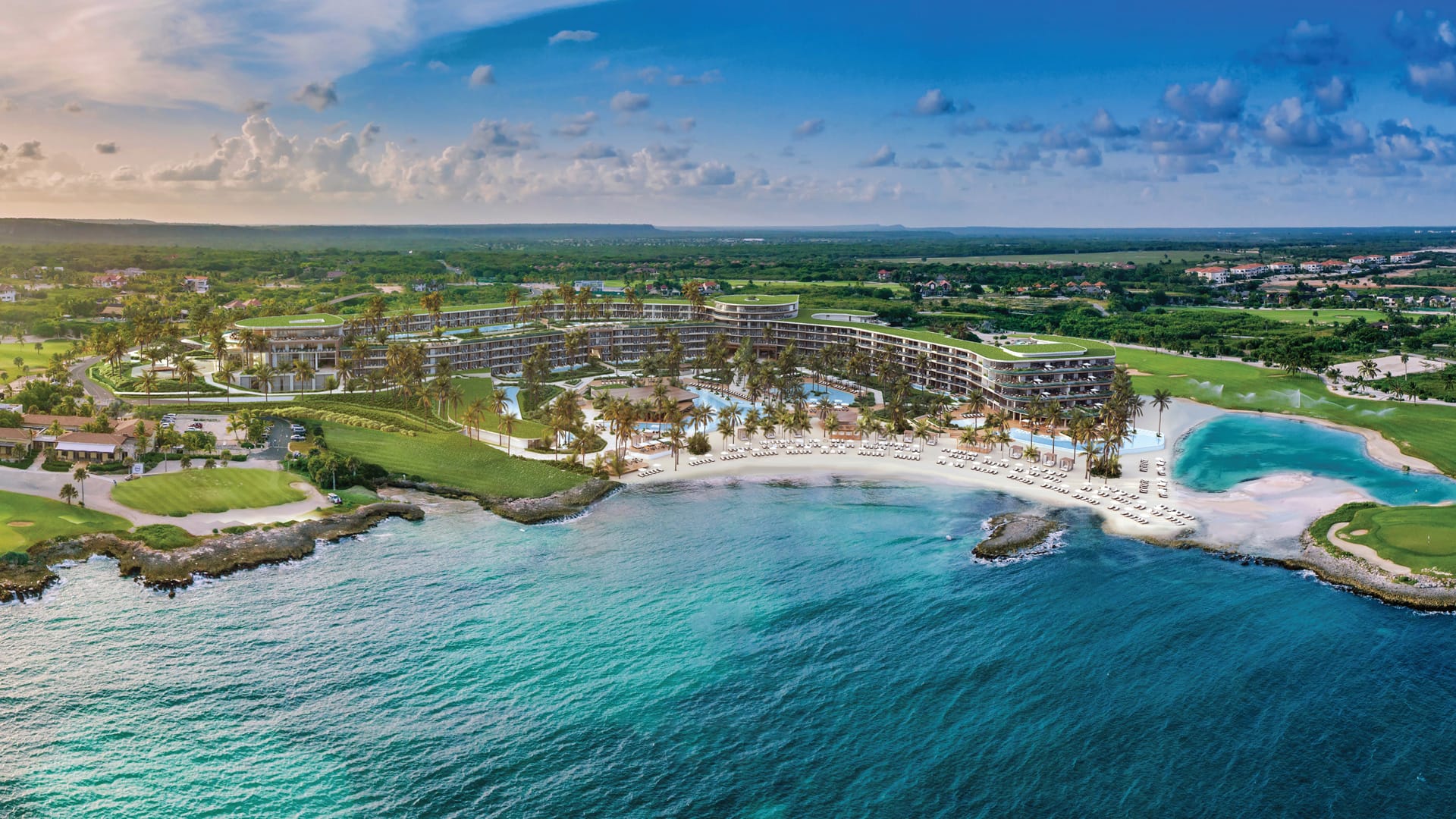
Cap Cana
The Dominican Republic's gated resort town — marina, championship golf and the region's first five-star branded residences, with residency rather than citizenship.
- IslandDominican Republic
- AnchorMarina Cap Cana & Punta Espada golf
- OwnershipBranded residences & condominiums
- RouteDR residency — no citizenship program
Get the current price list for Cap Cana
Dan sends what is available now, including residences that are not advertised, with prices, floor plans and terms. He replies personally within one business day.
- Tell Dan what you have in mindBudget, timing and the kind of home. Two minutes, and it stays private.
- Get pricing and availabilityCurrent prices, what is genuinely available and what is coming, within one business day.
- Talk it throughA 30-minute call with Dan when you are ready. No fee, no obligation.
About Cap Cana
Cap Cana is a large gated resort community on the Dominican Republic's eastern tip near Punta Cana — thousands of acres behind a security gate, wrapped around Marina Cap Cana, the Jack Nicklaus-designed Punta Espada golf course, beaches and restaurants. It is an established town rather than a single resort, which is what separates it from most of what the Eastern Caribbean offers at the same price.
The branded arrival is the St Regis Residences, the first five-star branded real-estate offering inside the gates — beachfront condominiums, penthouses and golf-terrace residences on roughly 17 acres, with reported pricing from about US$1 million. Read the regime difference carefully: the Dominican Republic runs no citizenship-by-investment program. A purchase here buys a home and a straightforward path to DR residency, not a passport. If a second citizenship is the objective, the five Caribbean CBI programs are the place to look and Dan will say so.
Read Dan’s full review of Cap Cana
Cap Cana is a privately governed, gated destination on the eastern tip of the Dominican Republic. Inside one perimeter sit a marina, the Jack Nicklaus signature course at Punta Espada open since 2006, branded hotels including the St Regis that opened on 1 May 2025, and a large residential estate. It is about a ten-minute drive from Punta Cana International Airport. It is not a resort with houses bolted on. It is closer to a small private town that maintains its own roads, its own security, its own beaches and its own utilities, and bills you every month for the privilege. That distinction is the whole page.
The thing buyers get wrong here is the arithmetic. Punta Cana’s airport handled more than 11 million passenger movements in 2025, a 9.9% increase on 2024, across 35,092 flights, and that number gets put in front of you as though it were demand for your villa. It is not. The overwhelming majority of it is all-inclusive hotel traffic that will never look at a private home. Cap Cana is a very good lifestyle asset that happens to rent; it is not a yield instrument wearing a beach. Buy it as the first and you will probably be pleased. Buy it as the second and the carrying costs below will find you.
What you actually own when you buy in Cap Cana
Start with the good news, because it is genuinely good. There are no restrictions on foreign individuals or entities owning or leasing real estate in the Dominican Republic, and Article 25 of the Constitution entitles foreign nationals to the same rights and duties as Dominican nationals. You buy freehold, in your own name if you want to, on the same terms as a local.
What matters is the paperwork. Ownership is proved by a Certificate of Title issued by the Registry of Title — a completely different document from the deed of sale, and the only document that serves as proof of ownership. Standard due diligence includes obtaining a certified report from an independent surveyor confirming that the official survey coincides with the property and that there are no overlapping surveys. Cap Cana was master-planned and registered as an estate, which ought to make the title work straightforward, but that is a reason to verify quickly, not a reason to skip verifying. Use your own lawyer, not the one the sales office recommends.
You are also buying into a private governance regime. APROCAP, the Asociación de Propietarios de Cap Cana, is the non-profit designated by Cap Cana as the entity responsible for the administration and operational management of the destination. Its published general maintenance and security service covers a long list. Gardening and green areas, irrigation water, beach maintenance and cleaning. Common-area electricity, road maintenance, fumigation and refuse collection. Civil liability insurance, customer service and access control. Internal taxi and domestic-staff transport. And 24-hour security, medical and fire services. Read that list for what it does not include: golf and beach club access is a separate membership question, not something your title conveys. Ask what it costs, whether owners get a preferential rate, and whether that rate is contractual or discretionary.
The CONFOTUR tax exemption is not what the brochure implies
Nearly every new-build pitch in Cap Cana leads with CONFOTUR. Law 158-01 exempts approved tourism projects from a list of taxes — its article 4 exemptions amended by Law 184-02, its term and its first-buyer restriction set by Law 195-13. That list includes the real property transfer tax and the annual IPI property tax, running from the date the construction works are completed. That is real money and it is a legitimate reason to prefer an approved project.
Two things get glossed over. First, the term. You will see both ten years and fifteen quoted, including ten on the tax authority’s own help pages, and it is usually presented as an unresolvable conflict. It is not one. The original Law 158-01 set ten years; article 9 of Law 195-13 replaced article 7 to give quince (15) años, a partir de la fecha de terminación de los trabajos de construcción y equipamiento — fifteen years from completion of construction and equipping. The help-portal text is stale drafting rather than a competing legal reading. Read the project’s own resolution anyway: it is the document that tells you when that clock started.
Second, and this is the part that rarely gets said out loud: the amended law restricts the benefit to those who invest directly with the promoters. It expressly excludes cualquier transferencia posterior a favor de terceros adquirientes — any subsequent transfer in favour of third-party purchasers. The tax authority’s own published guidance repeats the exclusion in the same terms. On the face of the statute and the official guidance, this is a first-buyer benefit. It does not automatically ride along to whoever buys from you.
Three consequences worth weighing before you sign:
- The clock starts at project completion, not at your closing. A building finished five years ago has already burned five of the fifteen.
- When you sell, your buyer may well pay the full 3% transfer tax and start paying IPI. Model that haircut into your exit price now, not at exit.
- Plenty of brokers in this market will still tell you the exemption transfers, and some practitioners argue the project-level classification carries through. Get a written opinion from a Dominican tax lawyer who is not connected to the developer, and read the resolution yourself.
What it really costs to hold a home in Cap Cana
There are two layers of association fee here, not one, and quotes that mention only the building fee are incomplete.
- Destination fee. APROCAP publishes its general maintenance and security charge at US$32.41 a month per room — its own wording is por habitación. How "room" is counted for a private house is a question to get answered in writing before you commit.
- Residential or building fee. Charged on top. APROCAP states only that the residential maintenance fee varies by residential zone and publishes no figure. Cap Cana buildings have historically quoted this per square metre. A March 2022 trade report put Bulevar Towers at US$2.65 per square metre a month, inclusive of insurance and the Cap Cana owners’ association charge. It put a nine-block development at Caracolí at US$60 a month. Treat both as order of magnitude and four years stale. Ask for the current schedule, three years of actual increases and the reserve fund position.
- Dominican taxes. The 3% transfer tax on the way in, the annual IPI on what you hold, 18% ITBIS on the professional fees, and — since June 2026 — a 10% tax on an individual’s gain when you sell. The rates, the thresholds and who actually bears each one are on the Dominican Republic real-estate guide. Two dates to diarise from here: IPI falls in two instalments due no later than 11 March and 11 September, and the sworn declaration is filed in the first 60 days of the year. If your unit is CONFOTUR-exempt you pay no IPI until the term expires — and whoever buys from you pays it from their first year.
- Insurance. Hurricane season runs June to November, and hurricane deductibles in this market usually run 2% to 10% of the insured amount. On a Cap Cana villa that is a five- or six-figure first-loss position, not a rounding error.
Everything is dollarised — utilities, staff, pool and garden, generator fuel. There is no cheap way to hold a house inside a private town that maintains its own roads and beaches.
Renting it out, and the rule change happening right now
Branded residences at Cap Cana typically come with a hotel-operated rental program. The trade is real: you get professional management and international distribution, and you give up a management share plus control over your own calendar. Read the owner-usage schedule, the blackout periods and the termination clause before you read the projected return. A pro forma is a marketing document; the management agreement is the deal.
On tax, payments abroad to non-residents without a permanent establishment attract Dominican withholding. The non-treaty rate is 27% on royalties, technical assistance and other services, and 10% on dividends and interest. Reduced rates apply under the handful of treaties in force. How your rental income is actually taxed depends on whether you hold personally or through a Dominican company, and on who collects the money. That is a question for a Dominican tax adviser you engage and pay, not for the sales office. If you are a US person, note this carefully: US citizens and green-card holders are taxed by the United States on worldwide income regardless of where they live or where the income arises. No Dominican structure changes that, foreign tax credits reduce double taxation but not the filing obligation, and renouncing citizenship is the only exit.
The rules are also moving. The Ministry of Tourism has a draft resolution creating a mandatory National Registry of Tourist Accommodation (RENATUR) covering all properties used for short-stay vacation rental. It would require owners, administrators, service providers and hosts to be registered with the Ministry before a property can be listed, and would give digital platforms a 60-day window after which they must stop promoting and servicing any unregistered Dominican property. Public consultation opened on 20 May 2026 and closed on 22 July. That closing date is widely reported as an implementation date; it never was one. What actually happened is that the Ministry pulled the draft from its portal, and the industry association’s account is that entry into force is suspended while a dialogue process runs, with no meeting dates set. As at early August 2026 nothing had been signed, and the industry was still publicly asking for a technical working group first. One detail that changes the timing if it does land: the draft gives owners a six-month adaptation period after approval. If your purchase case depends on short-term letting, that is live risk — and registration is a precondition to being listed at all, not a form you file afterwards.
For context on the base you are building on. Across the wider Punta Cana short-term rental market, AirROI recorded 34.2% occupancy and a US$155 average daily rate. Average annual revenue was US$10,793 across 2,197 active listings, on trailing-twelve-month data updated 30 July 2026. Cap Cana prices well above that market, so its own numbers will not look like those. No Cap Cana-specific occupancy or revenue data could be found from a source worth standing behind — and neither, probably, can the person quoting you a yield. Ask them where the number came from.
The risks worth raising unprompted
Cap Cana’s own arguments are newness, the volume of new-build inventory it sells, and a location about ten minutes from Punta Cana International Airport. If you will use the house six or eight times a year on short trips, that airport proximity is worth more than it sounds on paper. Set against it, this is a young enough estate that its resale history is thin — which matters more than most buyers allow for.
Now the things nobody volunteers:
- Off-plan risk here is documented history, not theory. The Trump Organization attached its name to a Cap Cana development in the years before the 2008 crash. It was never completed, and as ABC News reported, buyers "who staked millions on lots for their dream homes were left empty handed." The Trump side sued the developers; the case was settled, and by 2017 the site remained largely barren. Cap Cana has plainly recovered; the St Regis opened here on 1 May 2025 with 200 guest rooms including 36 suites. Even so, structure your deposits like someone who read that story: escrow, construction milestones, and a completion guarantee with a name behind it.
- Sargassum. Cap Cana is often marketed as immune. It is not. A 2026 account of this coastline notes that Cap Cana was the first area in Punta Cana to install offshore barriers, but that they have not been as effective as elsewhere. Small particulates still drift in and leave the water murky, and Juanillo beach is particularly affected. The same account calls 2025 an exceptional year for seaweed, with quantities flooding the Caribbean from late May to August at levels not previously experienced. Visit in May or July before you buy, not in February.
- Resale liquidity. One brokerage’s area guide puts Cap Cana property at US$300,000 to over US$20 million. The top of that band is a small pool of buyers. On resale you compete against a developer who can offer a brand-new unit with a live CONFOTUR exemption while, on the face of the law, you cannot.
- There is no citizenship here. The Dominican Republic runs no citizenship-by-investment program. This is residency only, and buying property does not by itself confer status.
Price a specific building on a specific floor
One brokerage’s area guide puts the range at US$300,000 to over US$20 million, which tells you almost nothing useful — Cap Cana spans everything from a modest golf-view apartment to an oceanfront estate. Price a specific building on a specific floor, then price it again net of both association fees, the CONFOTUR position, and what a resale buyer will realistically pay if your exemption does not transfer to them. The headline number is the least informative figure in the deal.
You buy outright, in your own name
What you must not skip. Ownership is proved by the Certificate of Title issued by the Registry of Title. That is a different document from the deed of sale, and it is the only one that serves as proof of ownership. Commission an independent surveyor’s certified report as well, confirming that the official survey coincides with the property and that there are no overlapping surveys. Use your own lawyer. A company structure is sometimes used for tax or estate reasons, not because ownership requires it.
The Dominican Republic runs no citizenship programme
The Dominican Republic runs no citizenship-by-investment program, so it is not comparable to St Kitts and Nevis, Antigua and Barbuda, Grenada, Dominica or St. Lucia, which do run one. What exists is a permanent residency route for foreign investors putting in US$200,000 or the equivalent, under migration law 285-04 and regulation 613-11, registered through the national export and investment centre (CEI-RD). Naturalisation is a separate administrative process under Law 1683. It can be applied for after a period of uninterrupted residency, with property ownership as one qualifying ground. But it is a discretionary grant, not an entitlement that follows a purchase. And if you are a US person, none of it changes your US position: US citizens and green-card holders are taxed on worldwide income wherever they live, and renouncing is the only exit.
Two layers of fee, plus taxes
APROCAP, the association designated to administer the destination, publishes a general maintenance and security fee of US$32.41 a month per room. Your own residential zone or building charges a separate fee on top; APROCAP publishes no figure for it and says only that it varies by residential zone. Cap Cana buildings have historically quoted per square metre. A March 2022 trade report put one tower at US$2.65 per square metre a month, including insurance and the destination charge. Treat that as historical and demand the current schedule. Add IPI at 1% on taxable real-estate patrimony above RD$10,695,494 if the unit is not CONFOTUR-exempt, plus insurance and dollarised utilities. Before signing, ask for three years of actual fee history and the reserve fund position: a low fee with an empty reserve is a special assessment waiting to happen.
Short-stay letting works today; the framework is being rewritten
Today, generally yes, subject to your building’s rules and to any hotel rental program you have signed up to. But the framework is being rewritten. On 26 May 2026 the Ministry of Tourism announced a mandatory National Registry of Tourist Accommodation (RENATUR), covering all short-stay vacation rental properties. The draft would require owners, administrators, service providers and hosts to register with the Ministry before a property can be listed. It would also give platforms a 60-day window, after which they must stop promoting unregistered Dominican properties. Implementation scheduled for 22 July 2026 was suspended for further dialogue. Do not underwrite a purchase on today’s rules, and check your own condominium’s by-laws separately — they bind you regardless of what the Ministry decides.
Sargassum reaches this coastline, whatever you are told
Yes, and it is worth pushing back when someone tells you otherwise. A 2026 account of this coastline notes that Cap Cana was the first area in Punta Cana to put barriers in the water, but that they have not been as effective as elsewhere. Small particulates still drift ashore and leave the water murky, and Juanillo beach is particularly affected. The same account describes 2025 as an exceptional year, with seaweed flooding the Caribbean from late May to August at levels not previously experienced. It varies year to year and month to month, but see the beach yourself in late spring or summer before you commit, not in the clean months.
A good place, sold with arithmetic the carrying costs do not survive
It is a genuinely good place, sold with investment arithmetic that does not survive contact with the carrying costs. Four specifics. The CONFOTUR exemption is a first-buyer benefit. On the face of the law and the tax authority’s own guidance it does not pass to your resale buyer, so your exit price may carry a tax haircut you should model now. The fee stack has two layers and is entirely dollarised. The short-term rental market is thinner than the airport traffic implies, and the rules governing it are being rewritten this year. And the estate has documented history of an off-plan project that took buyers’ money and never got built. None of that is a reason not to buy. It is a reason to buy the house rather than the pro forma.

Dan Merriam
“With almost 20 years of experience as a real estate investor and a deep understanding of the Caribbean market, I can provide a behind-the-scenes perspective that the sales team won’t.”
Dan Merriam is a licensed real estate and investment migration professional who has lived full-time in the Eastern Caribbean since 2021. He and his team have handled more than US$75M in transactions across the region in the past 24 months, from resale villas to new-build residences and CBI-approved property. They show homes in person or by live video and walk you through what each one really costs to own.
Explore Cap Cana with Dan.
Send a private inquiry to see current availability, ownership structure and pricing.
Request a Consultation