
St Kitts & Nevis now has a firm end date for citizenship by investment. Here is what it means for property, and for your family's timing.
Last updated: 26 November 2026.
Two weeks ago, Prime Minister Dr Terrance Drew told the nation that St Kitts & Nevis would wind down its Citizenship by Investment program, and that the final date would be announced once it was agreed with the European Union. I wrote about that address in The World's Oldest Passport Program Is Shutting Down, and the biggest open question then was simple: when?
On 26 November 2026, the Prime Minister's Office answered it.
Here is what was agreed, what it means for property in St Kitts & Nevis over the long term, and why, if your family is seriously considering this, the time to start looking at homes is now and not in 2028.
What was announced on 26 November 2026
In a statement from the Prime Minister's Office, published by the Citizenship by Investment Unit, the government said that after extensive negotiations it has reached agreement with the European Union on the responsible wind-down of the program by 1 January 2030. The key points:
- The Unit will continue to receive new applications until 31 January 2029.
- Applications submitted before 1 February 2029 may continue to be processed until 31 December 2029, and all processing will be concluded by that date.
- No reduction in pricing, investment thresholds or due diligence standards during the transition. The program continues "under the strictest standards in its history," every agreed safeguard stays fully in place, and the regional regulator, ECCIRA, will monitor compliance.
- The reason given: the decision was "about more than visa-free travel to Europe." It protects the Federation's place in the international banking system, including its links to correspondent banks in the United States, Canada and Europe that card payments, remittances and imports depend on, and the good name it has rebuilt over the last four years.
- What comes next: the government says the European Commission stands ready to keep working with St Kitts & Nevis during the transition, including on diversifying the economy, and that talks have already begun on geothermal energy, digital connectivity and other projects under the EU's Global Gateway strategy. The government will use the transition to complete CBI-funded projects already in the pipeline and accelerate diversification under its Sustainable Island State Agenda.
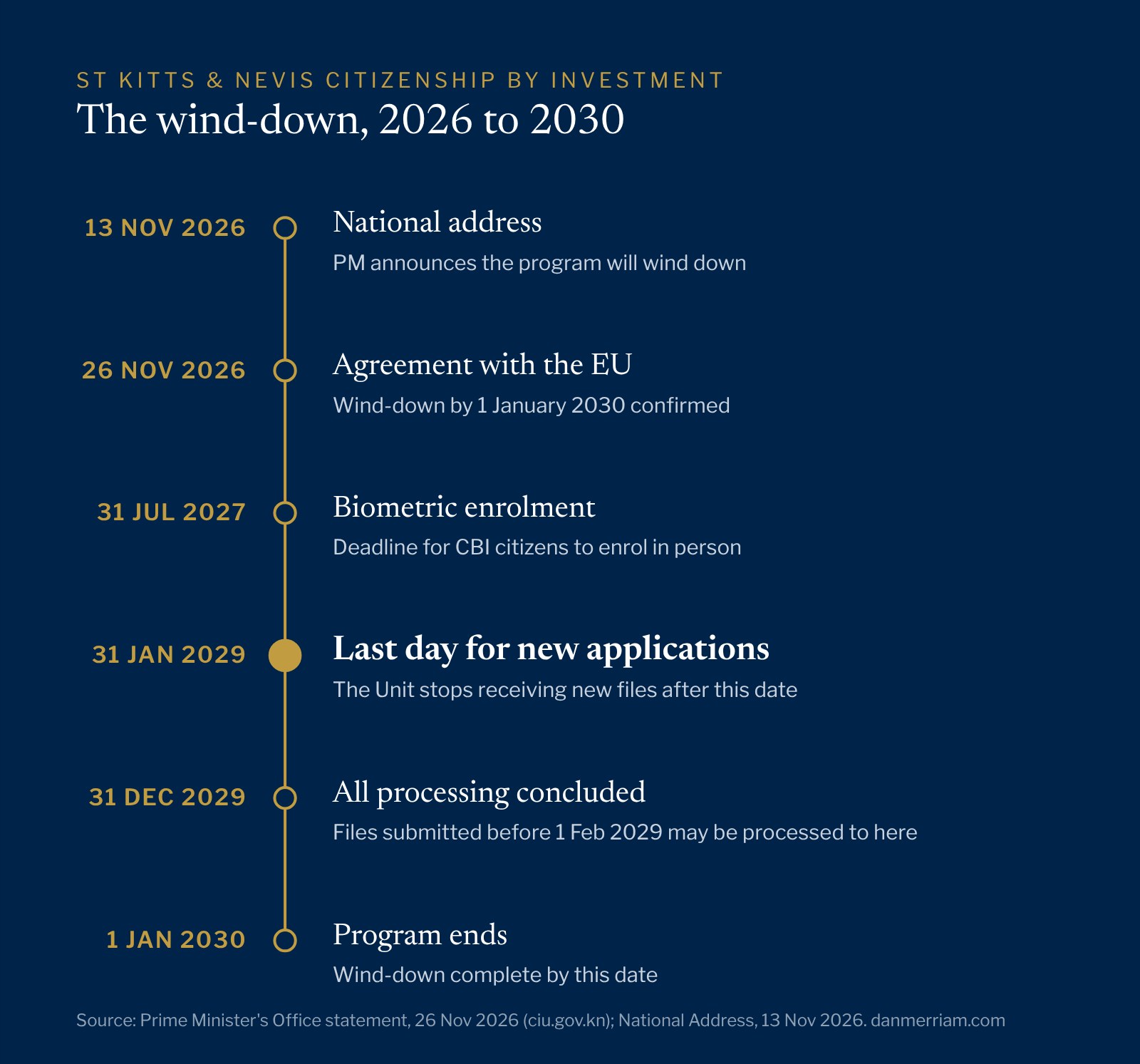
The government described this as more than three years for an orderly wind-down, a timeline it says was secured at the negotiating table. That is a generous runway by any standard, and the statement credits the reforms carried out since 2022 for the trust the EU placed in the Federation.
What has not changed
It's worth being just as clear about what this announcement did not do.
- It did not close the program. Until 31 January 2029, St Kitts & Nevis is open for applications under its current rules.
- It did not cut prices. The Prime Minister promised in his address there would be "no rush, no discounts, and no fire sale," and this statement confirms there will be no reduction in pricing or investment thresholds.
- It did not change anything for existing citizens. The 13 November address was explicit on that. If you are a citizen by investment, the date that matters to you is still 31 July 2027, the deadline for completing biometric enrolment in person.
- It did not change the rules for property you already own. Nothing announced alters your title or the terms you bought under.
What this means for St Kitts & Nevis real estate over the long term
This section is my own analysis. It is not a forecast of prices, and nobody can honestly give you one. But I have spent years helping families buy here, and some things about the next decade are reasonably clear.
1. There is now a fixed, final window for CBI-driven demand. For forty-two years, property in St Kitts & Nevis has had a buyer who could appear in any year: the family buying partly for citizenship. That buyer now has a known last date. Between now and early 2029, every family that wants citizenship through real estate has to make its decision inside the same window. After that, the citizenship-driven buyer stops arriving.
2. Approved developments now have a deadline too. The government has said it will use the transition to complete CBI-funded projects in the pipeline. In practice, the developments that are well advanced, well capitalised and already delivering will be in the strongest position. Projects that are early or uncertain have less time to raise what they need. For a buyer, that makes the quality and progress of the development matter more than ever.

3. After 2029, the market becomes a lifestyle and investment market. This is the long-term shift, and I think it is the healthy one. The buyers who come after CBI will be people who buy because they want to own here: for the beaches, the resorts, the safety, the climate, the short flight from North America, and the way of life. In my experience, the families who were happiest with their purchase bought for those reasons anyway. Their property was never just a passport receipt.
4. The economy the government is building points the same way. In the 13 November address, the Prime Minister set out where he intends to take the economy after CBI: geothermal energy in Nevis and a link to St Kitts, a 50-megawatt solar plant, P&O Cruises home porting two ships in St Kitts from November 2027, a new cruise terminal at Port Zante, yachting on the Southeast Peninsula, and a sovereign wealth and resilience fund created by law in 2026. The 26 November statement adds that talks with the European Commission have already begun on geothermal energy and digital connectivity. Cheaper power, better connectivity and more visitors are the things that make property worth owning, whoever the buyer is.

5. Owners who bought through CBI keep what they bought. A home bought through the program is still a home in St Kitts & Nevis. When you eventually sell, your buyer may be a lifestyle buyer rather than a CBI applicant, so it matters that you bought something people want to live in or rent. Check the resale terms in your own purchase contract, and take advice on them.
What I won't do is tell you prices will go up or down because of this, in the short or the long run. Anyone who gives you a number is guessing. What I can tell you is what I see on the ground, and I'll keep reporting it honestly as the transition unfolds.
Why families should start viewing properties now
Thirty-one January 2029 sounds a long way off. It isn't, for three reasons.
The deadline is for a submitted application, not a decision. To have a file in before 1 February 2029, you need to have chosen a property, completed the purchase steps, gathered your family's documents, and passed through your authorised agent's preparation, all before that date. Each step takes time, and none of them can be rushed without risk. I explained what delays an otherwise clean application in what 100+ families taught me.
Due diligence is not getting lighter. The government's statement is clear that there will be no reduction in due diligence standards. A file with gaps gets delayed, and a delay near a deadline is the one you can't afford. Starting early gives you room to fix problems while there is still time to fix them.
The best choices go first. Every family that wants this has the same window. My expectation, and it is only that, is that the well-located, well-built homes in the strongest developments will be chosen by the families who visit early. Families who wait until late 2028 will choose from what is left, under time pressure, with everyone else doing the same thing.
So here is what I would suggest if this is a serious option for your family:
- Visit, and see the homes in person. You are buying a property you may own for many years. Walk it, see the neighbourhood, and meet the developer.
- Look at the development as hard as the home. Ask how far along it is, how it is funded, and what its completion timeline is.
- Start your documents early. Talk to your authorised agent about what your family will need, and begin gathering it now.
- Buy for the place, not just the deadline. If the only reason is a date on a calendar, step back. The families who do best here are the ones who would want the home anyway.
You have more than two years. That is enough time to do this properly. It is not a reason to wait.
None of this is legal advice. Take your specific situation to qualified counsel.
Where it stands
- St Kitts & Nevis and the European Union have agreed that the Citizenship by Investment program will end by 1 January 2030.
- New applications are accepted until 31 January 2029.
- Applications submitted before 1 February 2029 may be processed until 31 December 2029, when all processing will be concluded.
- Pricing, investment thresholds and due diligence standards will not be reduced. ECCIRA monitors compliance.
- Existing citizens are unaffected. CBI citizens must complete biometric enrolment in person by 31 July 2027.
- The government will use the transition to complete CBI-funded projects and diversify the economy. Talks with the European Commission have begun on geothermal energy and digital connectivity.
Frequently asked questions
When does St Kitts & Nevis citizenship by investment end? The program will end by 1 January 2030. New applications are accepted until 31 January 2029.
What is the last date to apply? 31 January 2029. Applications submitted before 1 February 2029 may be processed until 31 December 2029.
What happens to my application if it isn't approved by 31 December 2029? The government has said all processing will be concluded by that date. Ask your authorised agent how that applies to your file, and submit early enough that it isn't a concern.
Will prices be reduced before the program closes? No. The government has said there will be no reduction in pricing, investment thresholds or due diligence standards.
Can I still buy real estate in St Kitts & Nevis after 2029? Yes. The wind-down ends the citizenship program, not property ownership. Buyers after 2029 will be buying for the property and the place, without citizenship attached.
Does this affect my existing St Kitts & Nevis citizenship? No. The government has said nothing changes for anyone who lawfully holds its citizenship. CBI citizens still need to complete biometric enrolment by 31 July 2027.
Is any of this legal advice? No. I'm a licensed real estate agent, not a lawyer or a licensed citizenship agent. Take your situation to qualified counsel and your authorised agent before you act.
If your family is weighing St Kitts & Nevis and wants a straight read on timing, developments and what to look for when you visit, request a consultation. You'll get the trade-offs, not a pitch. You can also see what currently qualifies on my CBI-approved real estate in St Kitts & Nevis page.


