
For most of its independent life, Dominica did not have a weak property market. It had no property market at all.
That is not a figure of speech. Until 2011 there was no five-star hotel on the island. There was almost no freehold product built for a foreign buyer, no branded residence, and little reason for any of it to exist — because there was no way for the buyer to arrive and nowhere for them to stay when they did. Land changed hands between families. Estates were bought and sold as agricultural assets. What did not happen was the thing every other island in the Eastern Caribbean was doing by the 1980s: selling a piece of the view to somebody from somewhere else.
Fifteen years later Dominica has two Michelin Keys, a Relais & Châteaux membership, an Autograph Collection hotel, an InterContinental, a Curio, and roughly 500 rooms added in a single year. Understanding how that happened is the most useful thing a buyer can do before deciding what to pay here, because the sequence explains which parts of this market are durable and which are not.
Disclosure: this practice has a commercial interest in Secret Bay property sales. Secret Bay is central to this history on the record — first five-star hotel, first Relais & Châteaux, the awards. Where a claim is contested or self-designated, it is flagged as such below.
The whole change, in one comparison
| Dominica in 2010 | Dominica today | |
|---|---|---|
| Five-star hotels | None | Two Michelin Keys, a Relais & Châteaux membership, an Autograph Collection hotel, an InterContinental, a Curio |
| Product for a foreign buyer | Almost none — no branded residence | A branded residential market, most of it built since 2019 |
| Room supply | Static for decades | Roughly 500 rooms added in a single year |
| What land was | An agricultural asset traded between families | A priced asset sold to people from somewhere else |
Fifteen years separate those two columns. That is a very short time for a market to come into existence, and markets that appear that quickly are worth understanding before you buy into one — because the sequence tells you which parts of it are durable and which are an artefact of how it was financed.
Three events did it, and only one of them was planned. The first was a single hotel opening in 2011, built for reasons that had almost nothing to do with the property market and everything to do with a family. The second was a catastrophe. The third was a wave of construction that arrived in four years having failed to arrive in the previous twenty-four, and whose funding source explains both its speed and its unevenness.
Taken in order they also produce a test — one that separates the developments on this island that survived from the ones that did not, and that still applies to anything you are shown today. It is the last section, and it is the only part of this history that is really about your money.
Before the market: an estate economy
Dominica became independent in 1978. Ten months later, Hurricane David hit it as a Category 5 and flattened the housing stock, the agriculture and most of the infrastructure. The country began its independent existence in a rebuild.
What it rebuilt was agriculture. The estates — Belfast, Castle Bruce, Geneva and dozens of smaller holdings — had grown limes, then coconuts, then bananas, and bananas were the crop that mattered. Under the Lomé Convention from 1975, Windward Islands bananas held protected access to the European market at prices the open market would never have paid. At the peak in the early 1990s, banana earnings ran at roughly a fifth of Windward Islands GDP. Dominica’s steep, wet terrain grows a small, high-quality banana at a high cost per tonne, which was viable only because of the preference.
Then it wasn’t. Chiquita and the Hawaii Banana Industry Association petitioned the US Commerce Department in September 1994; the United States, Guatemala, Honduras and Mexico took the EU banana regime to the WTO in September 1995; the preference unwound over the following decade. Banana earnings fell to under 5% of GDP. By 2002 Dominica had gone to the IMF.
This is the part of the story that explains everything after it. Dominica did not choose tourism as a strategy. It ran out of alternatives. And it arrived at tourism with no hotel stock, no airport that could take a jet, and an economy already dependent on whatever the next external cheque was going to be.

The first generation: Phillip Nassief
If you want a single figure for the transition from estate economy to something else, it is Phillip Nassief.
He built Dominica Coconut Products from the 1960s — an industrial manufacturer, not a plantation, taking a local crop and processing it into soap and consumer goods. It became one of the largest private employers on the island. In 1995 he sold it to Colgate-Palmolive, which is a sentence worth sitting with: a Dominican manufacturer sold to a New York-listed multinational, in the same decade the banana trade was being dismantled.
Before that, in 1988, he had bought the Belfast estate and rum operation, and the Fort Young Hotel in Roseau. Fort Young was struggling. He expanded it over the following years into the island’s principal international hotel, and it remains the anchor of the family’s hospitality business.
He held the Dominica Award of Honour from 1977, and in 2002 CARICOM named him one of the Caribbean’s leading voices of the twentieth century. He died at his home at Belfast on 28 April 2024, aged 91.
Two things about that record matter to this history rather than to his obituary.
The first is that he bought a hotel because nobody else would. Fort Young was not an investment thesis in 1988; it was a distressed asset in a country with no tourism industry. The purchase reads, in hindsight, as a bet that Dominica would eventually need somewhere for visitors to stay. It took twenty-three years for the second half of that bet to arrive.
The second is that he owned a half-acre on a headland above a beach near Portsmouth, and he sold it to his son.
2011: the year the market started
Gregor Nassief did not begin as a hotelier. He built an international supply-chain software business operating from Venezuela to Chile — the kind of career that usually ends somewhere other than a rainforest cliff on a Caribbean island of 66,000 people.
He had played at the beach below that headland as a boy. He married the Venezuelan contemporary artist Sandra Vivas. And her father, Fruto Vivas — one of the significant Venezuelan architects of the twentieth century — drew the plans for a villa on the half-acre as a wedding gift.
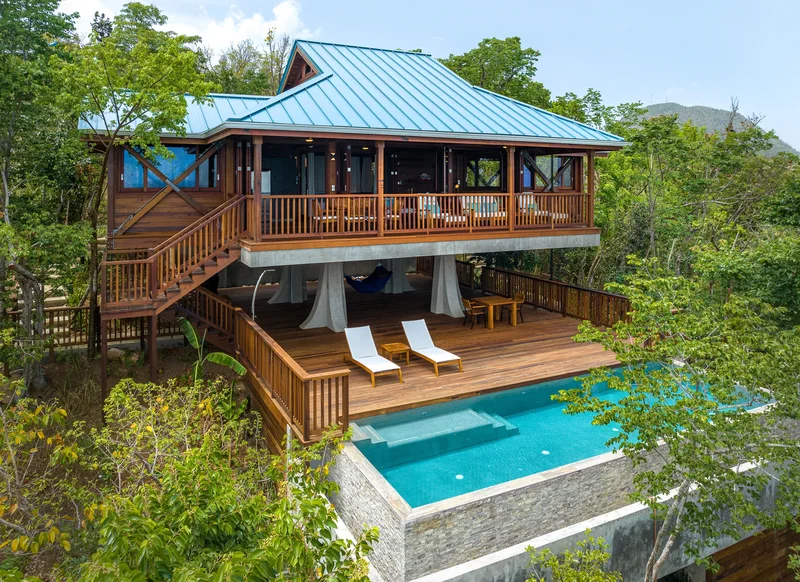
That villa was Zabuco, built on the spot where the Nassiefs had intended to put their own house. It took the resort’s first guest instead. Secret Bay opened in 2011 as the first five-star hotel in Dominica’s history.
It is worth being precise about how unusual that was. In 2011 Dominica had a citizenship programme eighteen years old, a national economy still recovering from the banana collapse, an airport that could not take a jet from Miami reliably, and no luxury hospitality of any kind. A resort of six villas, built by a software entrepreneur to a Venezuelan architect’s drawings, using Guyanese greenheart floors and Dominican red cedar furniture made by local craftsmen, was not a market response. There was no market to respond to.
Two years later, in 2013, Travel + Leisure put it on the cover under the headline "Secret Caribbean," with a ten-page feature saying Dominica finally had a world-class resort to match its natural assets. That sentence did more for Dominican property than any government marketing budget of the period. It is the moment the island became visible to the people who buy villas.
The lesson the market took from it — correctly — is that Dominica’s product is the nature, and the way to sell the nature is to build almost nothing. Six villas on a headland, not two hundred rooms on a beach. Every credible development on the island since has been some version of that idea.
2017: Maria, and the reset
Hurricane Maria made landfall on 18 September 2017 as a Category 5 and did to Dominica what David had done in 1979. Housing, agriculture, roads, the grid. The country lost a substantial share of its GDP in a night.
The tourism industry effectively ceased. Secret Bay closed. Jungle Bay, on the southeast coast, had already been destroyed once and was rebuilt on the southwest coast, reopening two years after Maria.
Secret Bay reopened on 1 November 2018 — thirteen months — with six villas: Zabuco I, II and III, Ylang Ylang I and II, and a new, larger Ti-Fey. Every villa now had a private plunge pool. The rebuild added the Zing Zing restaurant, and moved the spa and wellness pavilion to a riverside site. It came back as a materially better property than the one the storm destroyed. The villas it sells today are set out in Secret Bay’s waterfront villas.
That is the second structural fact about this market, and it is the one buyers most often get backwards. Maria did not set Dominican development back. It reset the standard. The country committed to rebuilding to a resilience specification and set itself the goal of becoming the world’s first climate-resilient nation. Building codes tightened. Almost everything a foreign buyer looks at on this island today is either post-2017 construction or was substantially rebuilt after 2017 — which is a materially different proposition from the 1980s and 1990s stock that dominates several better-known Caribbean markets.
That claim has a second half. A resilience standard is a standard for new construction. It does not make the island safe from a Category 5, and any buyer who reads it that way has misread it. What it does is change the expected cost and duration of the next recovery.
2019 onward: the branded wave
Everything a visitor now recognises as Dominica’s hotel industry arrived in a five-year window after the storm.
October 2019 — Cabrits Resort & Spa opened at Douglas Bay near Portsmouth as a Kempinski, 151 rooms, the first internationally branded hotel in Dominican history. It re-flagged to InterContinental under IHG in 2023 and trades today as InterContinental Dominica Cabrits Resort & Spa. It was financed through the citizenship programme.
Late 2019 — Secret Bay was accepted into Relais & Châteaux, the first and at the time only property in Dominica, and one of only eight in the Caribbean.
2016 — GEMS Holdings Limited had been established as the vehicle holding Fort Young and Secret Bay, turning two properties into an operating group with a management structure behind it. That is a duller milestone than a hotel opening and probably a more consequential one.
October 2022 — Coulibri Ridge opened in the far south: 14 suites on 285 acres, entirely off-grid, after roughly twenty years of planning. It is the purest expression of the build-almost-nothing thesis on the island.
Anichi Resort & Spa at Picard Beach, Portsmouth — 128 rooms on 12 acres, in Marriott’s Autograph Collection — and Tranquility Beach Resort, 73 keys of villas and condo suites in Hilton’s Curio Collection, both came out of the citizenship-financed pipeline in the same period. Both have taken materially longer than their marketed timelines, which is the ordinary condition of citizenship-financed hotel construction across the region rather than anything specific to Dominica.
By 2025 the effect was visible in the aggregate. Dominica added roughly 500 rooms in one year, a 25% increase in national hotel inventory. Total passenger arrivals reached 488,091, up 13% on 2024 and 49% on 2019. Stay-over arrivals including yachts hit 112,195 — a record. Direct visitor spending was estimated at EC$405.5 million.

Where the awards came from
Awards get quoted loosely in property marketing, so it is worth separating what is verifiable from what is asserted.
Verifiable. Secret Bay holds two Michelin Keys and is a member of Relais & Châteaux. It was named #1 resort hotel in the Caribbean, Bermuda and the Bahamas in Travel + Leisure’s World’s Best Awards in 2020, 2022, 2023 and 2024, four times in five years, and placed #6 hotel in the world in the 2020 reader poll. It placed #2 in 2025 and #6 in 2026, the latest awards as of October 2026. It took World Travel Awards’ Dominica’s Leading Hotel in 2023 and Caribbean Journal’s Best Boutique Hotel in Dominica in 2023. Gregor Nassief was named Caribbean Journal’s Caribbean Hotelier of the Year, and is president-elect of the Caribbean Hotel and Tourism Association.
Those are third-party awards from named bodies with published methodologies, which is the only kind worth pricing.
Not verifiable. The "six-star" description that circulates in Dominica marketing is a self-designation. There is no six-star rating system. It is the one claim in the file that does not survive contact with a source, and it is worth naming because the rest of the record does not need it.
And a note on how to read a reader-poll award at all. Travel + Leisure’s World’s Best is a reader vote weighted by who answers the survey. A small property with an intense guest relationship outperforms a large one on that measure structurally. That does not make the result meaningless — winning a regional category four times in five years against every resort in the Caribbean, Bermuda and the Bahamas is not a sampling artefact — but it measures guest devotion rather than construction quality, and those are different things to underwrite.
What the record shows
Strip the narrative out and Dominica’s development history produces four findings a buyer can use.
One: the operator is the asset. Every project on this island that got built and stayed built had an operating business behind it — a hotel group, a management company, a family that had run something before. Fort Young worked because someone ran a hotel. Secret Bay worked because a group formed around it. Coulibri Ridge worked because its owner spent twenty years on it. The developments that stalled were, disproportionately, the ones marketed primarily as a route to a passport, where the citizenship sale was the business model and the hotel was the pretext.
Two: scale is the wrong instinct here. Dominica’s terrain, planning posture and product all point the same direction. There is no cruise terminal reshaping the capital and no high-rise coastline. The properties that command a premium are 6, 14, 20 keys. A buyer looking at a large-inventory scheme in Dominica should ask what changed about the island to make that work.
Three: the money came from citizenship, and that cuts both ways. The CBI programme, running since 1993, financed Cabrits, Anichi, Tranquility Beach and the airport now under construction at Wesley. Without it Dominica would have very little of the hotel stock it has. It also means the island’s development pipeline is exposed to a single revenue line that is currently under external pressure — a US proclamation restricting entry for Dominican nationals from January 2026, and a European Commission letter of 25 June 2026 asking all five Caribbean programmes to phase out by 1 June 2028. Nothing has been suspended, and the current status is tracked in full here.
Four: the market is fifteen years old. That is the fact underneath every liquidity question a buyer should ask. There is not yet a deep record of resale in Dominican luxury property, because there has not yet been time for one. First-generation owners at the best properties have largely not sold. That is not evidence of a strong resale market, and it is not evidence of a weak one. It is an absence of evidence, and pricing it as anything else is the commonest error made here.

What this history tells you about buying here today
The useful conclusions are narrow, and they are mostly about what to check.
Ask who operates it, and what else they operate. This is the single strongest predictor in fifteen years of Dominican development history. A named operator with a track record on the island is worth more than a brand licence attached to a project that has not broken ground.
Ask when it was built. Post-2017 construction to the resilience standard is a genuinely different asset from pre-Maria stock. On an island where the last two Category 5s arrived in 1979 and 2017, that is not a detail.
Price the access, don’t price the airport. The international airport at Wesley is real, under construction and now targeted for the second quarter of 2028, and it is the single largest catalyst in this market. It is also about three years late already. The full state of that project is here.
Treat the citizenship and the property as two decisions. The programme built this market. It is also the market’s largest external risk. Underwriting a villa on the strength of a passport, or a passport on the strength of a villa, is how people end up holding an asset they did not want.
And expect thin liquidity, because fifteen years is not long enough to have produced anything else. The buying mechanics, closing-cost stack and resale problem are set out on the Dominica market guide, and what the island charges an owner is on the Dominica tax page.
If you want a view on where a specific property sits in that history — who built it, who runs it, and what it has done — request a consultation.
Four decades in seven lines
- Dominica had no luxury property market before 2011. The economy was agricultural, the banana preference collapsed through the 1990s, and the country went to the IMF in 2002. Tourism was the fallback, not the plan.
- Phillip Nassief bridged the two eras — Dominica Coconut Products from the 1960s, sold to Colgate-Palmolive in 1995; Belfast and the Fort Young Hotel bought in 1988; Dominica Award of Honour 1977; named by CARICOM in 2002 as one of the Caribbean’s leading voices of the century. He died in April 2024, aged 91.
- Secret Bay opened in 2011 as Dominica’s first five-star hotel, on a half-acre Gregor Nassief bought from his father, to drawings by the Venezuelan architect Fruto Vivas — his father-in-law — made as a wedding gift. The 2013 Travel + Leisure cover is when the island became visible to villa buyers.
- Hurricane Maria in September 2017 reset the standard rather than setting the market back. Secret Bay reopened thirteen months later, improved. Most of what a buyer sees today is post-2017 construction to a resilience specification.
- The branded wave is five years old, not fifty — Cabrits as a Kempinski in October 2019 and InterContinental from 2023, Relais & Châteaux for Secret Bay in late 2019, Coulibri Ridge in 2022, Anichi in Autograph, Tranquility Beach in Curio. Roughly 500 rooms were added in 2025 alone, a 25% jump in national inventory.
- The operator is the predictor. Projects with a real operating business behind them got built. Projects where the citizenship sale was the business model largely did not.
- The citizenship programme financed all of it, and is the market’s main external risk. A US proclamation restricted entry for Dominican nationals from January 2026, and the EU has asked all five programmes to close by June 2028.
Frequently asked questions
When did luxury real estate development begin in Dominica? 2011, with the opening of Secret Bay — the island’s first five-star hotel. Before that Dominica had an agricultural economy, a citizenship programme running since 1993 that funded budgets rather than buildings, and no luxury hospitality product of any kind. Everything a visitor now recognises as Dominica’s hotel industry was built after 2011, and most of it after 2018.
Who are the Nassief family and what did they build in Dominica? Phillip Nassief founded Dominica Coconut Products in the 1960s and sold it to Colgate-Palmolive in 1995. He bought the Belfast estate and rum operation and the Fort Young Hotel in 1988, rebuilding Fort Young into the island’s principal international hotel. He held the Dominica Award of Honour from 1977, and CARICOM named him one of the Caribbean’s leading voices of the twentieth century in 2002. His son Gregor founded Secret Bay in 2011 and established GEMS Holdings Limited in 2016 to hold both properties.
Who designed Secret Bay? The Venezuelan architect Fruto Vivas drew the original villa — Zabuco — as a wedding gift for his daughter, the artist Sandra Vivas, and her husband Gregor Nassief in 2011. It was built on the spot where the couple had intended to put their own house, and became the resort’s first guest villa instead.
Is Secret Bay really a six-star resort? No rating body issues six stars, so the description is a self-designation rather than an award. The verifiable record is strong enough without it: two Michelin Keys, Relais & Châteaux membership since late 2019, and Travel + Leisure’s #1 resort in the Caribbean, Bermuda and the Bahamas in 2020, 2022, 2023 and 2024, alongside a #6-in-the-world placing in 2020.
How did Hurricane Maria affect Dominica’s property market? Maria hit on 18 September 2017 as a Category 5 and devastated the island. Secret Bay closed and reopened thirteen months later with six villas and new amenities; Jungle Bay was rebuilt on a different coast and reopened two years on. The lasting effect was a tightened building standard and a national commitment to climate resilience, which is why most stock a foreign buyer sees today is post-2017 construction.
What role did the citizenship programme play in Dominica’s development? A decisive one. Dominica’s programme has run since 1993, and citizenship receipts financed Cabrits, Anichi, Tranquility Beach and the international airport now under construction at Wesley. That funding is also the market’s principal external risk: a US presidential proclamation restricted entry for Dominican nationals from January 2026, and the European Commission has asked all five Caribbean programmes to phase out by June 2028.
Which Dominica developments have been completed? Secret Bay (2011, rebuilt 2018), Fort Young Hotel in Roseau, Cabrits Resort & Spa at Douglas Bay (October 2019, now InterContinental), Jungle Bay on the southwest coast, and Coulibri Ridge in the far south (October 2022). Anichi at Picard Beach and Tranquility Beach have both run materially past their marketed timelines, which is the ordinary condition of citizenship-financed hotel construction across the region.


