
I work from Nevis. My office is at the Four Seasons, and most weeks I am driving the island road with a client in the passenger seat, pointing at things. So when I say Nevis is the most undervalued market I cover, it is not a slogan I picked because it sounded good in a headline. It is the conclusion I keep arriving at after showing people what their money buys here versus what it buys ninety minutes away in a better-known market.
Nevis is thirty-six square miles, fewer than twelve thousand people, one volcanic peak in the middle, and one road around the outside. There are no high-rises. There are no cruise ships unloading four thousand people into Charlestown. That is not an accident of development — it is policy, geography and a local administration that has been deliberate about what it will and will not approve.

What "undervalued" would have to mean
It is the easiest word in property to say and the hardest to defend, so let me set the test I think it has to pass before I spend three thousand words claiming it.
One: your money has to buy materially more here than in a comparable market. Not a nicer view for the same price — more house, more land, more title, more security, for less. That is a question about numbers, and the numbers are further down.
Two: the scarcity has to be structural, not a lull. A market is not undervalued because it is having a quiet year. It is undervalued when something durable — geography, planning policy, a government's settled preference — caps supply in a way that will not relax when sentiment turns.
Three, and this is the one most "undervalued" claims fail: there has to be a reason the discount persists that is not "nobody has noticed yet." Plenty of people have noticed Nevis. So either the market is wrong, or the discount is compensation for something real. I think it is the second, and the thing you are being compensated for is liquidity. That is a trade some buyers should refuse, and I would rather say so early than sell you an island.
This is the first-hand version — what buying here is like from the passenger seat of my car. The Nevis market page is the reference side of the same subject: live inventory, current pricing bands and the developments I represent. If you want availability rather than judgement, start there and come back.
Where Nevis is, and why its size matters
Nevis sits near the northern end of the Lesser Antilles, roughly 230 miles southeast of Puerto Rico, west of Antigua and north of Guadeloupe. It is the smaller half of the two-island Federation of St. Kitts & Nevis — and the two are genuinely different places to live, separated from St. Kitts by a two-mile channel called The Narrows.

Charlestown is the capital — Georgian buildings, a working harbour, the courthouse, the banks, and the place where every real transaction on this island eventually gets processed. It is also where Alexander Hamilton was born, which surprises most American clients.
The size is the whole point, and it cuts both ways. Thirty-six square miles with a mountain in the middle leaves a finite, quite small set of genuinely buildable, genuinely desirable coastal parcels. You cannot manufacture more beachfront on Pinney’s Beach. That constraint is what underpins values here.

The flip side, which I tell every client before they get emotionally attached: a small market is a thin market. Fewer buyers, fewer comparable sales, longer selling times. If you need to be out in six months, Nevis is the wrong island.
What makes Nevis different from the rest of the Caribbean
Four things, and they rarely appear together.
It is quiet by design. The island has consistently declined the mass-tourism model. The anchor is a Four Seasons and a golf course, not a cruise pier. That keeps visitor numbers low, keeps the character intact, and skews the buyer profile toward people who want to be left alone.
It is unusually safe. Crime is low in a way that is immediately obvious when you spend a week here, and it holds up against the rest of the region on the numbers. For families relocating with children, this is often the deciding factor rather than a nice-to-have.
It is politically stable and legally coherent. A parliamentary democracy in the Commonwealth, English common law, and a land registry that works. Nevis also has its own island administration with meaningful autonomy over local planning and land matters, which is why Nevis and St. Kitts do not always behave like one market.

It has a real financial-services layer. Nevis is known internationally for its LLC and international trust legislation — the same statutes I write about when clients ask whether a Nevis or Cook Islands trust stops a lawsuit. For families already structuring offshore, holding property and structure in the same jurisdiction is a genuine convenience.
What the Nevis property market looks like
Small, largely unlevered, and slower-moving than buyers expect.

There is no MLS in the sense a North American buyer understands. A meaningful share of the good inventory is not publicly advertised at all — it moves between agents and known buyers. Pricing is set by what sellers believe rather than by dense comparable data. Overpriced listings and genuine bargains sit side by side, and telling them apart is most of the job.
Transactions run on English-style conveyancing through local attorneys. Expect a longer timeline than you are used to: title searches, the licence process and, if the property is in a development, developer paperwork. Ninety days is a fast Nevis closing. Six months is not unusual.
Most purchases here are cash. Local mortgage financing exists but is limited for non-residents, and terms are unattractive compared with what buyers are used to at home. I wrote separately about getting a mortgage on a Caribbean villa as a foreigner — the short version is that most people fund from outside the region.
What you can buy in Nevis
Roughly four categories, and they behave very differently.
Branded resort residences. The Four Seasons is the anchor. Condominiums with golf or ocean views trade here, along with a limited number of villas, and the resort’s rental program is available. This is the most liquid, most understood, most "safe" end of the market — and priced accordingly.

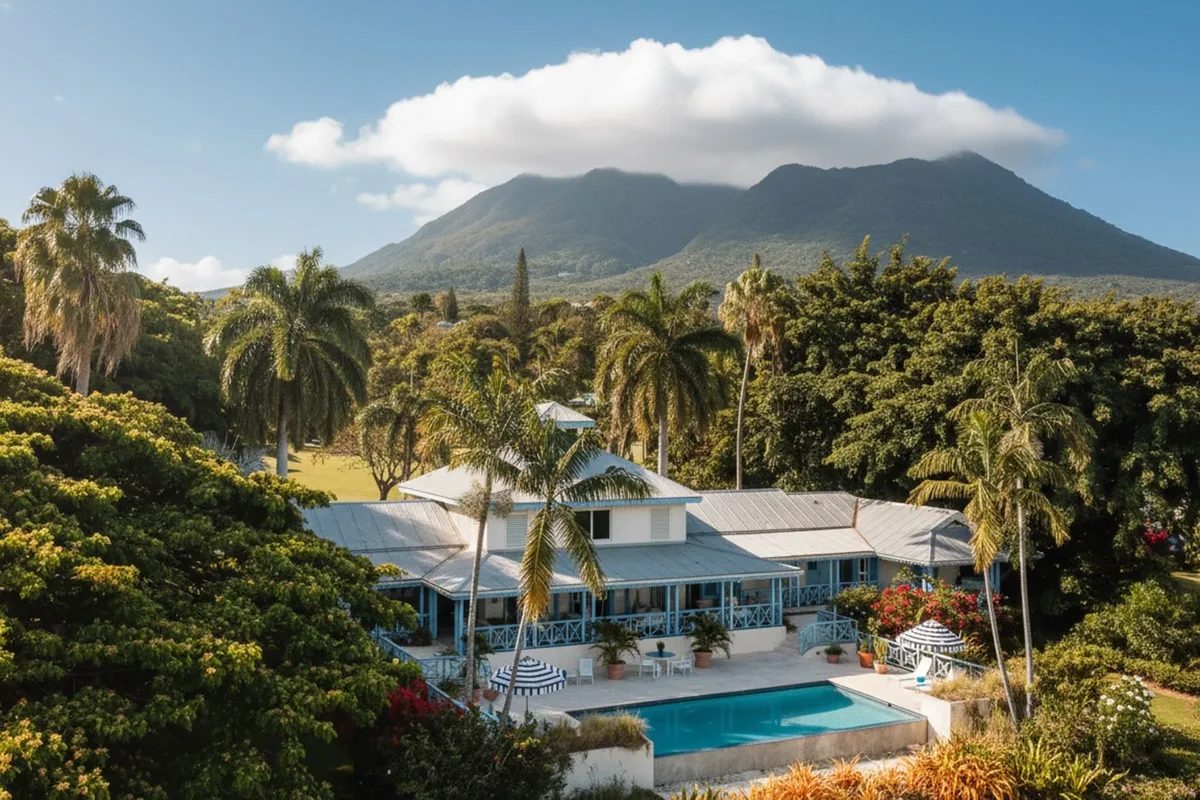
If you are weighing this against the alternatives, I compared Four Seasons Nevis against Park Hyatt St. Kitts on fractional ownership. I also asked whether the Four Seasons premium is worth paying.
New-build development residences. Purpose-built projects, several of which are approved under the citizenship program.

These carry the usual off-plan risks — completion, developer solvency, specification drift. If you are looking at anything pre-construction, work through the off-plan due-diligence checklist before you sign.
Plantation-era and traditional homes. Restored great houses and plantation-style properties, often inland and elevated. Enormous character, and a maintenance obligation that catches people out.

Land. Still available, still buildable, and the most common way people overestimate their own patience. Building on a small island where most materials arrive by boat takes longer and costs more than the equivalent build at home.
For a realistic sense of budget across the region, see what $300,000–$400,000 buys you in the Caribbean.
Nevis pricing, tier by tier
Calling a market undervalued and then declining to publish a number is a habit I dislike in other people’s writing, so here is the ladder as it stands on inventory I can currently stand behind. Figures are as at July 2026 and move with each release. Treat them as the shape of the market rather than a quote.
| What it is | Where | Size | Price (US$) | Implied $/sq ft |
|---|---|---|---|---|
| One-tenth deeded fractional interest, Villas at Pinney’s Beach (Four Seasons) | Pinney’s Beach | share of a 365 m² villa | from 375,000 | — |
| Two-bedroom beach condo, Nelson Spring | west coast | 65 m² / ~700 sq ft | 325,000 | ~465 |
| One-bedroom designer condo, Zen at Pinney’s Beach | Pinney’s Beach | 70 m² / ~755 sq ft | 425,000 | ~565 |
| One-bedroom beachfront apartment, CBI-approved | Nevis | 92 m² / ~990 sq ft | 430,000 | ~435 |
| Two-bedroom beachfront condo, Hamilton Beach Villas | Pinney’s Beach | up to ~2,770 sq ft reported | ~465,000–695,000 | — |
| Branded residence, Nevis Peak Residences (Four Seasons) | Four Seasons estate | 135 m² / ~1,455 sq ft | from 1,549,000 | ~1,065 |
| Whole beachfront villa, Villas at Pinney’s Beach | Pinney’s Beach | 365 m² / ~3,930 sq ft | 4,150,000 | ~1,055 |
| Hillside villa, Mahogany Hill (Four Seasons) | Four Seasons estate | 295 m² / ~3,175 sq ft | 4,250,000 | ~1,340 |
| Private estate home, Ouje Mango Rif Huis (Villa 1801) | Four Seasons estate | 559 m² / 6,021 sq ft | 8,750,000 | ~1,450 |
The dollar-per-square-foot column is my own arithmetic — asking price divided by the stated interior area, not a market survey. Interior-area conventions vary between developments. Read it as a rough band, not a valuation.
What the band tells you is the actual structure of this market. Branded Four Seasons product trades at roughly US$1,065–1,450 per square foot. Unbranded condominium stock on the same coast trades at roughly US$435–565. That gap is what you are paying for the brand, the management and the resale story. It is the number to argue about before you argue about a view.
Two figures I am deliberately not publishing, because I do not have inventory I would defend behind them:
- Buildable land per acre by district. Jessups, Cotton Ground, Cliftons and Figtree all price differently. Land here moves privately, in small volumes, at whatever a particular seller believes that morning. Quoting a per-acre figure for each district would be inventing a comparables set that does not exist. Ask me for what is available and I will tell you what it is priced at and what I think it is worth.
- Plantation great houses. Genuinely one-off assets. A restored eighteenth-century estate is not a category with a range; it is four or five properties that rarely trade. Same answer: ask, and I will tell you what is quietly on and off the market.
Current availability sits on the Nevis market page and in current listings.
How a foreigner buys property in Nevis
This is the part that surprises people, and it is not optional.
A non-citizen buying property in St. Kitts & Nevis generally requires an Alien Landholding Licence. Under the Aliens Land Holding Regulation Act the fee is 10% of the property’s value. Approval typically takes around three months — call it twelve to fourteen weeks from a complete application, inside an overall transaction that runs three to six months. On a US$1.5M purchase that licence is a US$150,000 line item, which is why discovering it at closing rather than at offer is such an expensive way to learn about it.
The main exception matters, and it is worth real money: property purchased under an approved citizenship-by-investment project generally proceeds without a separate licence, and the 10% fee does not apply, because the investment is already being vetted through the program. Be careful with the related claim agents repeat — that the fee is "waived in most developments." That is not a standing policy. Nevis ran a genuine 90-day fee waiver in 2020 as a pandemic measure, and the language has outlived it in marketing copy by years. The real, ongoing exemption is the CBI one.
I have watched buyers budget the full 10% against a purchase that was already CBI-approved and never needed it. I have watched the reverse too — a beautiful non-approved villa where the licence quietly added six figures to the price. I set out what the Alien Landholding Licence costs and how long it takes, island by island, in detail.
Beyond the licence, budget for legal fees of roughly 1–2.5% and an assurance fund contribution of roughly 0.2–0.5%. If you are buying into a development, add service charges and any rental-program terms. Stamp duty depends on the development: developers often have a government concession on part of the usual rate, new developments often charge it to the buyer, and I would slow down before quoting you an exact rate, because sources I trust disagree, citing anywhere from 6% on condominiums to 12% on other property types. Confirm it deal by deal with the attorney rather than from anyone’s article, including mine. None of it is unusual. All of it is easier when someone has told you in advance.
Where on the island to buy
The island reads differently depending on which side you are on.
Charlestown and the west coast. The capital, the harbour, the practical centre. Close to Pinney’s Beach and the Four Seasons. This is where convenience lives.

Jessups and Cotton Ground. North of Charlestown along the leeward coast, close to the beach and the resort, and where a lot of the villa inventory sits.

Cliftons and the north. Quieter, with sea views and a different feel again.

Figtree and the interior slopes. Elevated, green, cooler, with the long views people fall in love with. Further from the beach, and the roads are what they are.

My standard advice: rent here for a season before you buy, on the side of the island you think you want. The gap between the Nevis people imagine and the Nevis they enjoy living on is usually about ten minutes of driving and one hundred feet of elevation.
Where CBI touches the Nevis market
St. Kitts & Nevis runs the oldest citizenship-by-investment program in the world, established in 1984. It has been tested, revised and scrutinised for four decades.

Two routes are relevant to a property buyer: a government contribution, or a qualifying investment into approved real estate. The real-estate route means the qualifying outlay buys an asset you own rather than a fee you pay. That is the entire reason many of my clients choose it.
Here are the actual numbers, as at August 2026:
| Route | Threshold (US$) | Hold period | Notes |
|---|---|---|---|
| Sustainable Island State Contribution | 250,000 | n/a — it is a payment, not an asset | Covers the main applicant or a family of up to four; +25,000 per additional dependent under 18, +50,000 per dependent 18 or over |
| Approved development real estate (condominium or share) | 325,000 | 7 years | Cut from 400,000 in late October 2024 — the only price reduction anywhere in the region since the 2024 reforms |
| Approved private dwelling (single-family home) | 600,000 | 7 years | Cut from 800,000 at the same time |
On top of the threshold, due diligence runs US$10,000 for the main applicant and US$7,500 per dependent aged 16 and over. Post-approval government fees add US$25,000 for the main applicant, US$15,000 for a spouse and US$10,000–15,000 per dependent depending on age. Build those in — a US$325,000 real-estate route is not a US$325,000 exercise.
I have written the comparison of donation versus real estate using two real case studies, and more broadly on why American clients keep choosing St. Kitts & Nevis.
Two caveats I would not want you to miss. First, not every attractive property on Nevis is an approved CBI property. If citizenship is part of your objective, the approved-project list constrains your choices considerably. Know that before you fall for a villa that cannot deliver it. Second, this is a live file. In June 2026 the European Commission wrote to all five Eastern Caribbean programs, demanding they be phased out by mid-2028 or risk Schengen access. The standoff is unresolved as I write. Nothing about that argues for panic. Everything about it argues for buying real estate you would be content to own if the passport rules changed. Full detail on the program sits on the St. Kitts & Nevis program page. Confirm current thresholds and hold periods with a licensed agent before you commit to any of them.
The tax position on Nevis
St. Kitts & Nevis levies no personal income tax and no inheritance tax, and no capital gains tax on individuals in the ordinary case. That is the headline, and it is genuinely attractive.
One qualification on the capital-gains line, because it gets stated too flatly nearly everywhere — including, until this revision, on this page. The exemption is built for people who hold. Under section 3 of the Income Tax Act, a gain on an asset disposed of within one year of acquisition is taxed at half the income tax rate, capped at 20%. Since 1 May 1980 that charge has applied only to companies, so an individual buying in their own name is outside it and a company buyer is not. For a company buyer, the "no capital gains tax" line is a long-hold proposition rather than an unconditional one. If your plan involves buying and reselling quickly, get the current rule and the qualifying holding period confirmed by local counsel before you model the exit. Note separately that CBI-qualifying property carries its own seven-year resale lock, which for most buyers here bites long before any tax rule does.
The caveat I repeat constantly: your tax position is determined by where you are tax-resident, not by where you own a house. Buying in Nevis does not, by itself, change what you owe at home. Americans remain taxed on worldwide income regardless of where they live or hold property. Canadians need to sever residency, which is a specific and evidenced process. See how the CRA decides you have left Canada.
Owning here can be one component of a plan built around tax residency. It is not a plan on its own.
Who Nevis is right for
It works well for families who want a safe, private, low-tax base with real property rights and are content with a quiet island. It works for buyers pairing a property purchase with a second citizenship. It works for people who intend to use the place.

It works poorly for anyone who needs liquidity, expects appreciation on a fixed timetable, wants a lively social scene, or is buying purely on rental yield projections. Caribbean rental income is harder to earn than the spreadsheets suggest — I went through why Caribbean rental cashflow is harder than it looks separately.

One current development belongs in any full picture of the market. In August 2026 the homeowners association at Four Seasons Nevis filed suit against the owner of the resort assets over the standard and funding of the resort’s shared facilities; the owner says it will defend the claims and considers them without merit. I set the filing out neutrally in an objective look at the Four Seasons Nevis lawsuit. It is worth reading if you are buying at or near that resort — and worth reading in proportion. My own view is that a claim of this kind puts real pressure behind the amenity and renovation programme already in planning, and that existing and incoming owners are more likely to see that work accelerate than stall.
Nevis is private, safe, tax-neutral and structurally undersupplied. Those four things rarely coexist, and that combination is why I moved my own work here rather than to a busier market. But it rewards buyers who are patient and punishes buyers who are in a hurry.

If you want to talk through what is available right now — including the part that never reaches a listing site — request a consultation. You can also browse current Caribbean listings or read the wider Nevis market guide.
The Nevis case in eight lines
- Nevis is 36 square miles with fewer than 12,000 people, anchored by a Four Seasons rather than mass tourism — scarcity here is structural, not marketing.
- The ladder, as at July 2026: from about US$325,000 for a beach condo, US$375,000 for a Four Seasons one-tenth fractional interest, US$425,000–430,000 for turnkey one-bedroom condos, from US$1.4M for branded residences, US$4.15M–4.25M for beachfront and hillside villas, up to US$8.75M for a private estate home.
- Branded Four Seasons product runs roughly US$1,065–1,450 per square foot against roughly US$435–565 for unbranded condominium stock on the same coast — that gap is the brand premium, and it is the number worth arguing about.
- Foreign buyers can own freehold, but generally need an Alien Landholding Licence — 10% of the property’s value, around three months — or buy through an approved CBI project, where the licence and its fee generally do not apply at all.
- The market is thin: little public inventory, limited comparables, mostly cash, and 90 days is a fast closing.
- St. Kitts & Nevis runs the world’s oldest CBI program (1984): US$250,000 by contribution, US$325,000 in approved real estate on a seven-year hold, or US$600,000 for an approved private dwelling, plus due-diligence and government fees on top.
- No income or inheritance tax locally, and no capital gains tax in the ordinary case — but short-hold disposals by a company can be taxable, and owning property does not change your tax residency at home.
- Right for patient buyers who will use the property; wrong for anyone who needs liquidity or a fixed appreciation timetable.
Frequently asked questions
Can foreigners buy property in Nevis? Yes. Non-citizens can own property freehold in St. Kitts & Nevis, but generally must obtain an Alien Landholding Licence first. Under the Aliens Land Holding Regulation Act the fee is 10% of the property’s value. Approval typically takes around three months. Property bought through an approved citizenship-by-investment project typically does not require a separate licence, and the 10% fee does not apply.
What does property cost in Nevis? As at July 2026, entry sits around US$325,000 for a beach condo, US$375,000 for a one-tenth deeded fractional interest at Four Seasons Nevis, roughly US$425,000–430,000 for turnkey one-bedroom condos and beachfront apartments, from about US$1.4M–1.5M for branded residences, US$4.15M–4.25M for beachfront and hillside villas, and up to US$8.75M for a private estate home. On implied dollar-per-square-foot, branded Four Seasons product runs roughly US$1,030–1,450 against roughly US$435–565 for unbranded condominium stock on the same coast.
How much does the Alien Landholding Licence cost in Nevis? Ten percent of the property’s value, with approval typically taking around three months. On a US$1.5M purchase that is a US$150,000 government fee, and it belongs in the offer, not the closing statement. Buying inside an approved citizenship-by-investment development generally exempts you from both the licence and the fee. Budget separately for legal fees of roughly 1–2.5% and an assurance fund contribution of roughly 0.2–0.5%. Stamp duty depends on the development: developers often have a government concession on part of the usual stamp duty, and new developments often charge it to the buyer, so confirm it deal by deal.
Is Nevis a good real estate investment? It suits investors who value scarcity, stability and privacy over liquidity. Buildable coastal land is genuinely limited, and the island has resisted mass-market development. The citizenship program adds a layer of international demand. But it is a thin market with few comparable sales and long selling periods, so it is poorly suited to anyone who may need to exit quickly.
Do I get citizenship if I buy property in Nevis? Not automatically. Citizenship requires investing through an approved government-designated project and completing the full application and due-diligence process. As at August 2026 the thresholds are US$250,000 by contribution, US$325,000 in approved development real estate on a seven-year hold, or US$600,000 for an approved private dwelling, plus due-diligence fees of US$10,000 for the main applicant and US$7,500 per dependent aged 16 and over. Buying an ordinary property on the open market does not confer citizenship. If citizenship is one of your goals, confirm a property’s approved status before you commit.
Does buying in Nevis reduce my taxes at home? Generally no, by itself. St. Kitts & Nevis charges no personal income or inheritance tax, and no capital gains tax on individuals in the ordinary case. A company’s gains on assets sold within one year of purchase can be taxable, so confirm the holding period with local counsel if a quick resale through a company is part of the plan. Either way, your liability is driven by where you are tax-resident. Americans are taxed on worldwide income regardless of residence, and Canadians must properly sever residency. Property ownership can support a relocation plan, but it is not a substitute for one.
How long does it take to buy property in Nevis? Plan for roughly three to six months. The timeline is driven by title searches, English-style conveyancing through local attorneys, the Alien Landholding Licence application where required, and developer paperwork on new-build purchases. Ninety days would be a fast completion here.
Is Nevis safe to live on? Yes — it has notably low crime and is one of the reasons families choose it over larger, busier islands. It is a small community where people know each other, which is both the security model and, for some buyers, the adjustment.


